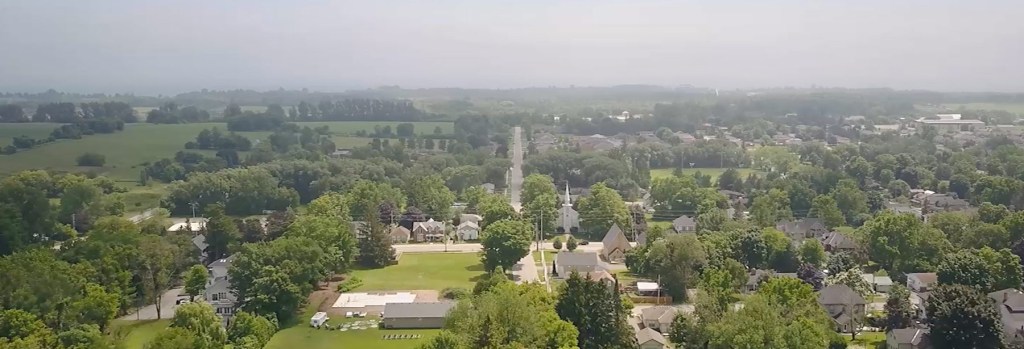
Cramahe Township is mostly rural and historically agricultural, stretching from Victoria Beach and the Ogden Point Quarry along Lake Ontario, north through the village of Colborne, home of the Big Apple, to the hamlets of Castleton in the west and Morganston in the northeast. You can find their Official Plan and Zoning By-Law on their Planning and Land Use page, along with information about applications for development.
For rural properties, be sure to check the area for active farms to see if you need to calculate Minimum Distance Separation from active barns; and also be sure to check if your property falls within the Oak Ridges Moraine, which limits ADUs beyond most other zones (see below).
Official Plan
80% of growth will be directed to the Colborne Urban Area, which is also the only area in Cramahe that has municipal services. Section 5.1.15 explicitly mentions the need for the full housing spectrum, “including housing that is designed to be affordable to moderate or lower income households.”
In that regard, Section 5.1.15.1 describes ADUs as Additional Residential Units or ARUs, a term often used interchangeably with ADUs (we’ll continue to use the term ADU here). The section defines them as a self-contained dwelling unit ancillary (subject or secondary) to the main dwelling on the same lot as a detached, semi-detached, or street townhouse dwelling, either in that same building or in a new or existing accessory building. Which is to say that almost anywhere you can have a house in Cramahe you can also have an ADU (subject to any restrictions in specific zones, below), provided the water and wastewater services can handle the load and the property fronts on a publicly maintained road.
5.1.16 notes that mobile homes and mobile home parks are “to be discouraged” in the municipality; it’s clear elsewhere that they’re only permissible in an approved mobile home park. To avoid confusion, we recommend a small modular home on a permanent foundation for your ADU so that it cannot be confused for a mobile home.
Zoning By-Law
There are six zones that normally allow for residential use: Rural (RU), Agricultural (A), Rural Residential (RR), and Residential Zone 1, 2, and 3 (R1, R2, R3), and therefore (as noted above in 5.1.15.1) allow for ADUs. Commercial zones also allow for accessory dwelling units, as noted below. But first, let’s explore the most relevant definitions and general usage that apply to all zones.
Definitions
- An Accessory Building or Structure (3.2) means a detached building whose use is accessory (in support of or secondary) to the main building on the lot but does not include dwellings; but goes on to note that additional dwelling units are permissible in accessory buildings according to other regulations below.
- 3.64 defines dwellings, including an accessory dwelling (accessory to a non-residential building and intended to be used by the owner or operator of a commercial or other establishment, and distinct from a secondary dwelling on a residential property); and a modular dwelling defined as a single detached dwelling manufactured to CSA standard A277 and according to the Building Code.
- 2.65 defines dwelling units, which include apartments, bachelors, condos, and other apartment-style complete dwelling units contained within a larger building; an accessory dwelling unit, being accessory to a commercial operation as above; and an additional residential unit, which we refer to elsewhere here as an ADU and would include a basement suite in a home.
- 3.138 defines a mobile home as “any dwelling that is designed to be made mobile, and constructed or manufactured to provide a permanent residence for one or more persons, but does not include a travel trailer or tent trailer.” Since many tiny homes are built on a chassis and wheels, they would fit this definition; as noted above, mobile homes of this definition are “discouraged” in the Official Plan, and limited to approved mobile home parks.
General Zone Provisions
Section 4.2.2 holds that in residential zones an accessory structure (including an ADU) must be behind or beside the main building, at least 3m from the main building and 1.5m from any other building on the lot, and at least 1.2m from any lot line. All accessory buildings combined cannot take up more than 5% of the lot.
Section 4.3 lays out all of the general regulations for accessory dwellings (i.e., ADUs in Commercial zones intended to house the owner or operator of the business):
- Only one ADU is permitted, so you may have to choose between an “additional dwelling unit” (inside the commercial building) or an “additional dwelling” (external, such as a converted garage or tiny home).
- An accessory dwelling cannot be within 3m of a non-residential use, or 7.5m of a motor vehicle garage or service station. No accessory dwelling units are allowed in motor vehicle garage or service station buildings.
- Accessory dwelling units have minimum footprints based on the size of the unit:
- Bachelor ADUs must be at least 37 sq m (398 sq ft)
- 1 bedroom ADUs must be at least 55 sq m (592 sq ft)
- 2 bedroom ADUs must be at least 65 sq m (700 sq ft)
- 3+ bedroom ADUs must be at least 83 sq m (894 sq ft) plus another 9 sq m (97 sq ft) for each additional bedroom after 3
- The maximum size of an ADU in an accessory building (i.e., a tiny home or converted garage) in any zone is 1,500 sq ft.
Section 4.24.1 lays out parking requirements, which are 1 off-street parking space per dwelling unit for detached, semi-detached, duplex, triplex, fourplex, or converted house dwellings (and their ADUs).
Section 4.39 lays out all of the general rules for Additional Residential Units including:
- They are permitted in Agricultural (A), Rural (RU), Rural Residential (RR), Residential 1 (R1), Residential 2 (R2), and Shoreline Residential zones with frontage on municipally maintained roads;
- They cannot be built in flood plains;
- They can be a maximum of 5m tall, unless they’re in the top storey of an accessory building (e.g., upstairs over a garage), in which case they can be up to 7m tall;
- They must be at least 3m from the main dwelling;
- In A or RU zones, the ADU can be in front of the main house provided the minimum front yard size for the zone is maintained;
- You can have up to 2 ADUs: one in the primary dwelling (e.g., a basement suite), called a dwelling unit; and one in an accessory building (e.g., a converted garage or tiny home), called a dwelling;
- If you have an ADU in your basement, it cannot be lower than your sanitary sewer outflow (very important!);
- ADUs cannot be bigger than the main dwelling;
- The ADU must be accessible outside (i.e., your tenant can’t be forced to walk through your house to get to theirs), and 1 parking space per dwelling is required, but a second driveway is not allowed.
Rural and Agricultural
Rural (RU) zone (see Section 5) lots are at least 25 hectares with a minimum of 150m of frontage and 12m of front yard. So if your home is, say, 30m from the road you’d have room to put an ADU between the road and the main house so long as it was at least 12m from the road(s). It must also be 12m from the rear lot line and 6m from a side lot line. RU zoning allows up to 2 dwelling units (1 single detached home and 1 ADU).
Agricultural (A) zone (see Section 6) lots are at least 38 hectares, and otherwise the same as the RU zone as described above regarding placement and number of ADUs. Both zones also allow for a bunkie to house seasonal agricultural workers, but that would require an Official Plan amendment for that lot and cannot be used for permanent housing.
Residential Zones
Rural Residential (RR) zones (see Section 7) allow up to 2 dwelling units, either with a single detached and 1 ADU or with a duplex or converted house with 2 units. The lot is a minimum of 0.4 hectares (1 acre) and 45m (150 ft) of frontage with minimum front and rear yards of 12m and side yard of 6m, the same as RU and A zones above. Unlike those zones, an ADU in an accessory building (i.e., a tiny home) cannot be in front of the main house.
Residential 1 (R1) zone (see Section 8) lot sizes vary widely depending on whether the lot is serviced by municipal water, sewer, or both; see the table on pages 163 for lot size and frontage requirements. Buildings must be placed at least 7.5m from the road(s) and rear lot line, and 1.2m from side lot lines in fully serviced lots and 3m from side lot lines in partially or privately serviced lots. No more than 1 dwelling and 2 dwelling units per lot, for a total of 3.
Residential 2 (R2) zone (see Section 9) lot sizes once again vary widely depending on the type of servicing, but also by the type of primary dwelling: R2 allows for single detached, duplex, semi-detached, and converted dwellings with up to 2 units. Where both units of a semi-detached home are on the same lot, or in the case of a duplex or a 2-unit converted home, the lot size is larger than for a single detached dwelling; where each unit of a semi-detached building has its own lot, it can be much smaller. See the tables on page 173-174. Buildings must be 7.5m from the road(s) and 3m from an interior lot line. You may have a total of 1 dwelling and 2 dwelling units.
Shoreline Residential (SR) zones (see Section 12) require a minimum lot size of 0.4 hectares (1 acre) and 30m of frontage, and allow 1 single detached dwelling and 1 dwelling unit (i.e., an internal ADU).
 Tiny Homes Northumberland
Leave a comment