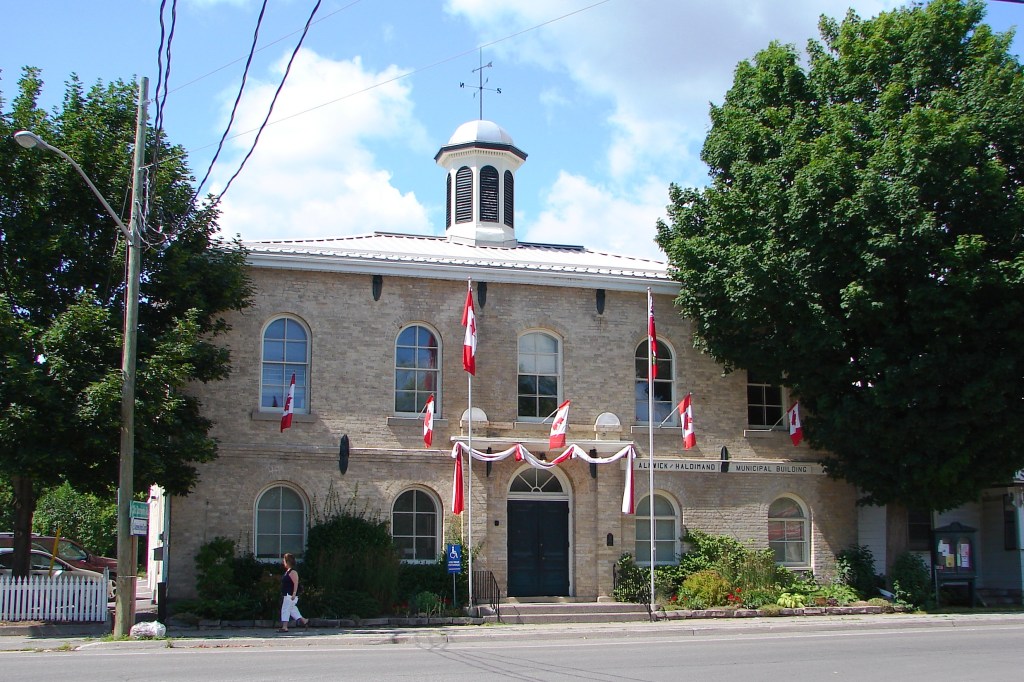
Alnwick/Haldimand is a rural township in central Northumberland, ranging from the hamlet of Grafton and Lakeport along Lake Ontario, north through the Northumberland County Forest, and to Roseneath and the eastern half of Rice Lake. Like neighbouring municipalities, the agricultural heritage of the area is evident not just in the local culture, but as a continuing core of the local economy.
Alnwick/Haldimand also lies within Hiawatha First Nations’ Traditional and Treaty Territories, and the entirety of the Alderville First Nation Reserve lies within A/H. If you have questions pertaining to lands within Alderville territory, contact the Alderville’s Administration Office.
Like Hamilton Township, Alnwick/Haldimand does not have any municipal wastewater services, and only one area (in the hamlet of Grafton) have municipal water services. That means that all homes in A/H rely on private septic systems, and the provisions in the Planning Act that allow for as-of-right ADUs in backyards in serviced areas do not apply. A significant portion of A/H is also Oak Ridges Moraine, where ADUs are not permitted. Nonetheless, tiny home ADUs are possible in A/H’s Official Plan and Zoning By-Law in rural settlement areas.
If you have questions about the development process in A/H, their Planning and Development page has a lot of information and contact information.
Official Plan policies relevant to ADUs
The Official Plan is a document that outlines the principles that govern all development within the municipality for decades at a time; the Zoning By-Law interprets the Official Plan and implements it on a zone by zone basis. The Official Plan (OP) directs almost all new development to Hamlet areas, but ADUs are allowed in rural areas as well; just be sure to note that Minimum Distance Separation requirements will apply if your proposed ADU is within range of an active agricultural operation.
Section 3.1.3 of the Official Plan is about Housing Policies, and there are a few noted here that are particularly supportive of ADUs, including noting the need for intensification through increased density–i.e., adding more people to established neighbourhoods through additional units, like ADUs. It also notes that it’s good to cover the whole spectrum of housing types. This section also acknowledges the need for affordable housing, with reference to the County Affordable Housing and Homelessness Plan and defining affordable as costing no more than 30% of the income of the household for low and moderate income households. Tiny home ADUs can help fulfill all of these objectives!
3.13.3 outlines the specific requirements for “Second Dwelling Units”, and defines them as “self-
contained residential units with kitchen and bathroom facilities within dwellings or within structures
accessory to dwellings (such as above laneway garages).” There are several requirements of all such units, but the most important points include:
- You can have an ADU in all land use designations that allow for detached, semi-detached, or town/row house, unless that zoning says otherwise (e.g., Oak Ridges Moraine zones do not allow ADUs, and Shoreline Residential, Limited Service Residential, Agricultural, and Rural zones also restrict their use).
- The language here (e.g., “Second”) seems to refer to a single ADU, as opposed to the Planning Act‘s 2 ADU limit (which doesn’t apply in unserviced areas, see above). So you’ll need to choose between an internal ADU (e.g., a basement suite) or an external ADU (e.g., a suite in a garage, or a detached tiny home).
- Your ADU must, of course, comply with all other relevant regulations such as the Building Code and Fire Code; and must be serviced by adequate water supply and wastewater system.
3.13.4 is a description of “Garden Suites”, a definition that refers to a former designation in the Planning Act that has been superseded by more modern understandings of ADUs. Garden Suites were designed to be an external ADU specifically only allowed on a temporary basis and only usable by a parent of the resident in the primary dwelling on the property. Unless you already have a designated Garden Suite, it isn’t recommended that you develop one, as current rules for “Second Dwelling Units” (above) are much more open and permanent.
Section 3.14 lays out what is required in a complete application for development, as well as urging residents to have a pre-consultation meeting with the Planner prior to starting on your application. We cannot recommend this enough: this website is only designed to familiarize you with the parts of the process most relevant to tiny home ADUs, but the pre-consultation meeting is essential to putting you on the right track to getting your application approved!
Section 3.20 notes that accessory dwellings are only permitted in zones that explicitly permit their use; it is important to note the definition of “accessory” in the Zoning By-Law (see below) refers to dwellings accessory to non-residential uses (e.g., a dwelling attached to a commercial enterprise or farm); so while 3.13.3 above seems to give blanket support for up to 1 ADU in (almost) all residential zones, section 3.20 refers to non-residential zones that may nonetheless allow for an accessory dwelling.
Zoning By-Law
The Zoning By-Law divides all of the land into zones according to their uses, including Rural, Agricultural, Residential (Rural, Hamlet, Shoreline, and Limited Service), Commercial, Industrial, Community/Open Space, Environmental, and Oak Ridges Moraine zones. We’ll look at each zone that allows for ADUs, either internal (e.g., basement suite) or external (e.g., detached tiny home or converted garage).
Definitions
The definitions section of the by-law has some key points for our purposes.
- An “Accessory Dwelling” refers to a dwelling attached to a non-residential use, e.g., a home attached to a store or farm.
- A “Coach House” is defined as “an additional dwelling unit on a lot that is located within an accessory building or structure” (e.g., a garage or detached tiny home).
- A “Dwelling, Modular” is defined as manufactured and assembled, with reference to CSA Standard A277 and the Ontario Building Code. Tiny homes would fit this definition, provided they’re built to that standard.
- A “Dwelling, Secondary” is defined to include another dwelling unit within the main house OR in an ancillary structure (i.e., as we’ve been describing it, an internal or external ADU).
- A Dwelling Unit is defined to include spaces for cooking, eating, living, sleeping, and sanitary facilities.
- A “Dwelling Unit, Accessory” again refers to housing attached to a business in order to house the owner or operator of that business, or for the housing of farm workers on a farm.
General Provisions
There are some parts of the zoning by-law that apply to every zone. Here are a few points relevant to ADUs:
- Accessory buildings (including ADUs) cannot be closer to the street than the main building, except in Rural Residential zones. So ADUs are for the backyard or side-yard, and must be at least 1.2m from the lot lines. See section 4.2.2 and 4.2.7
- An accessory building (including an ADU) must be at least 3m from the main building, and not be taller than the main building. See 4.2.3
- Accessory buildings cannot exceed more than 10% of the total lot area, and no single accessory building can cover more than 5% of the lot area. See 4.2.4
- 4.3 Accessory Residential Uses is particularly important, noting that a maximum of 1 ADU, either internal or external, is allowed on a lot; that it must be at least 3m from a non-residential use; and must be 7.5m minimum from an auto garage, dealership, or gas station, and is not permitted as an internal ADU in such a facility.
- Section 4.14 expands on the regulation of Garden Suites. Again, if you don’t already have a Garden Suite, try to avoid getting this designation; it is not required, and is quite restrictive.
- 4.27 regulates parking requirements. A main dwelling unit requires 2 parking spaces; an ADU requires 1 additional parking space. Read this section thoroughly for details of what is required in a parking space.
- 4.28 (c) forbids use of mobile homes in any zone other than the Mobile Home Residential zone, and 4.28 (d) forbids use of tents or trailers for permanent human habitation. To ensure that your tiny home ADU is approved, it is recommended to get a modular home installed on a permanent foundation.
- 4.30 Secondary Dwellings lays out 11 regulations for Second Dwellings:
- A detached, semi-detached, or row/townhouse may have 1 ADU, either internal (e.g., basement suite) or external (tiny home or converted garage);
- The ADU must be “clearly subordinate”, i.e., a Second Dwelling can’t be bigger or more prominent than the main building;
- An internal ADU can’t take up more than half of the total floor area of that building;
- If there’s already a Garden Suite on a property, another ADU is not allowed;
- One additional parking space is required for the ADU;
- An ADU must be serviced by municipal water, if it’s available;
- A lot must be at least 0.4 hectares to accommodate an ADU;
- The lot must have direct frontage on year-round municipal roads;
- The septic system must be sized appropriately, whether it’s shared with the main building or a separate system, as regulated by the County;
- ADUs are not allowed in flood plains or along private roads or unmaintained road allowances;
- External ADUs must be in the back yard, except in Rural Residential (RR), Rural (RU), Agricultural (A), or waterfront zones; combined buildings cannot cover more than 40% of the lot; maximum size of the ADU is 50 sq m if the main house is 100 sq m or less, or otherwise 50% of the size of the main house; the ADU must have rear and side yards of at least 1.2m, i.e., the ADU must be at least that far from the yard lines unless the specific zone says otherwise; have a maximum height of 4.5m, except in zones that explicitly say up to 7m; and the ADU must be at least 1.5m from the main house.
- 4.30.2 specifies where and how in the Oak Ridges Moraine an ADU might be allowed:
- Cannot be in the Oak Ridges Moraine Core or Linkage areas;
- Only 1 ADU, including any Coach House, Garden Suite, or Converted dwelling unit;
- ADUs in this area can only be in a single detached dwelling, not a semi-detached or row/townhouse as in other areas;
- Only internal ADUs are allowed, not external (i.e., a basement suite is allowed, but not a tiny home or converted garage).
Agricultural and Rural zones
Rural (RU) and Agricultural (A) zones have similar provisions regarding ADUs.
Rural lots (see Section 5 of the Zoning By-Law) must be at least 5 hectares with 60m of frontage, and buildings must be 12m from any frontage and 6m from any inside side lot lines and 12m from rear lot lines. The zoning permits a single detached dwelling, even converted to two units, and a secondary dwelling (2 dwellings total).
Agricultural (A) lots (see Section 6) must be at least 36 hectares with 200m of frontage, and buildings must be at least 22m from the road(s), 7.5m from interior side lot lines, and 12m from rear lot lines. The zone allows for single detached dwellings, even converted into two units, and a secondary dwelling (2 dwellings total). As above, Agricultural zones also allow for a seasonal bunkhouse for farm purposes.
Residential Zones
Rural Residential zones (RR, see Section 7) have lots that are at least 0.4 hectares (1 acre) with 45m of frontage; houses must be at least 12m from the road(s) and rear lot line, and 6m from the internal side lot line. The zone allows for a single detached dwelling, even converted into two units, and a secondary dwelling (2 dwellings total).
Hamlet Residential zones (HR, see Section 8) have lot sizes and frontage requirements that depend on whether the lot is serviced with municipal water or not, and whether the dwelling is a single detached home or a semi-detached or duplex; see the tables in Section 8 for more info. Buildings must be 7.5m from the road(s) and rear lot line, and at least 3m from an interior side lot line. The zone allows for single detached, duplex, semi-detached, and secondary dwelling (2 dwellings total). In areas with water services, both units of a semi-detached home can be on the same lot; this would preclude a secondary dwelling, as there’s two dwellings total allowed. But if only one unit of the semi-detached dwelling were on the lot, then an ADU would be allowed.
Shoreline Residential zones (SR, see Section 9) have lots that are at least 0.4 hectares (1 acre), with at least 60m of frontage. Buildings must be at least 12m from the road(s) and rear lot line, 6m from an interior side lot line, and 30m from the water. The zone allows for a single detached dwelling or seasonal dwelling, and a secondary dwelling.
Limited Services Residential zones (LSR, see Section 10) are for areas without year-round municipally maintained roads; new dwellings and secondary dwellings are not allowed.
Commercial Zones
Commercial zones in Alnwick/Haldimand allow for a dwelling accessory to the business as a place for the owner or operator of the business to live on-site. In General Commercial zones (GC, see Section 11) you may have a detached dwelling accessory to the business, or an accessory dwelling unit within the same building as the business (e.g., an upstairs apartment or basement suite) provided it is not on the ground floor and it must have access through the backyard rather than the front or side.
In Hamlet Commercial (HC, see Section 12) you may have an accessory dwelling within the non-residential building (i.e., in the business’ building), but no external secondary dwelling is allowed. The dwelling unit cannot be in the ground floor of the building, and no accessory dwelling is allowed in a “motor vehicle fuel establishment” (e.g., a gas station, auto mechanic, or car dealership).
Recreation Commercial (RC, see Section 13) is for resorts, trailer parks, etc. and allows for an accessory dwelling unit in the primary building or a detached accessory dwelling, similar to the General Commercial Zone.
Community Facility Zones
Community Facility zones (CF, see Section 17) are for municipal buildings, hospitals, clinics, senior centres, etc. They also allow for accessory dwellings, in a similar fashion to the GC and RC zones above, allowing for either an internal dwelling unit or a detached dwelling accessory to the primary facility.
 Tiny Homes Northumberland
Leave a comment