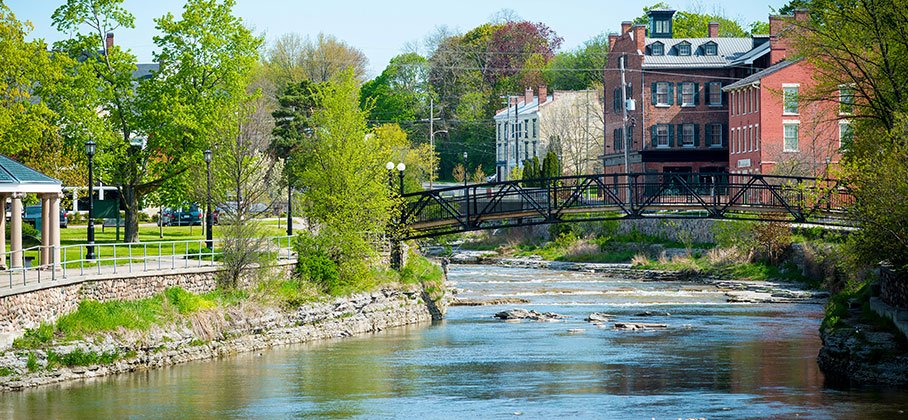
Port Hope, Ontario is known for the Ganaraska River, a historic downtown that hosts filming for television and movies, and a large rural area filled with agriculture and natural beauty.
To add a tiny home to a lot in Port Hope, you’ll need to know the following information:
- You can find the Port Hope planning website here. Planners strongly recommend attending a pre-consultation meeting to get a sense of what you’re planning to build and where. This can be very helpful, as you’ll leave the meeting with a checklist of everything you need to do to get your project approved.
- If you are applying to add a tiny home as an ADU (Accessory Dwelling Unit), you can do so through the Accessory Structure application form. It assumes you already understand the zoning; you can find the zoning bylaw here.
- In the zoning bylaw, Port Hope defines a “Garden Suite” which “is intended to be portable.” This allows for a tiny home on wheels. It also defines a “modular home” as a prefabricated unit placed on a foundation. Both are defined separately from a “mobile home.”
Section 4.2 of the zoning bylaw is all about Additional Residential Units. It notes that:
- ADUs can only be placed in lots along with a single-detached, semi-detached, or townhouse. So you can’t add a tiny home to an apartment building’s lot.
- A maximum of one detached ADU is allowed. While provincial law says up to 3 units per lot, that assumes that one is the primary dwelling and one is contained within the primary dwelling (e.g., a basement suite), while the third is in a garage or other accessory structure (like a garden suite or modular home). If you already have a suite in your garage, you can’t add another tiny home.
- An ADU can have a maximum of two bedrooms, and cannot have a basement or be underground.
- ADUs are subject to the same general requirements as the main house, including things like required parking spaces, setbacks from the street and side lot lines, required connection to municipal services where available, and minimum distance separation from agricultural operations.
- ADUs built on a rural or hamlet property serviced by a well need to be serviced by the same well as the main house. If the ADU is in an accessory building (like a detached garage) it can’t be further than 40 metres from the main house.
- If you’re in the Oak Ridges Moraine – Rural (ORM-RU) or Oak Ridges Moraine – Rural Settlement (ORM-RS) zones, only one ADU is allowed, and it must be in the main house (e.g., a basement suite); so no tiny homes are allowed in that area as ADUs. (Note that doesn’t prohibit a small main house.)
- A detached ADU can’t be more than 50% of the size of the main house; can’t take up more than 50% of the rear yard; and can’t exceed 70m2 in size. This is to prevent someone from building an ADU that looks like it’s just a second house on the same lot – but that’s exactly what an ADU is! Policies like these are evolving to better recognize that a house is a house, hopefully we’ll see some movement on this kind of logic in future Official Plans.
- An ADU can’t be more than 40m from the street, and can’t be taller than the primary house, or 5m, whichever is less.
- Some non-Residential zones allow for residences and ADUs. In Commercial zones, for example, there’s a maximum of 1 ADU, unless you’re in Downtown Commercial (COM3), in which case there is no limit. This is surely to accommodate apartments above the shops along Walton rather than garden suites in the back yard, but check with the Planners to explore what is possible.
Section 4.3 of the Zoning By-law addresses farm accommodations. The zoning doesn’t limit the number of buildings for farm workers, though it does set a limit of 80m2 of gross floor area. That could potentially mean several small (even tiny) houses. They must be on the same lot as the farmer’s residence, which must be more than 40 hectares. They must share a driveway with the main residence, and “the use is clearly secondary and accessory to the principal use on the same lot” (e.g., they can’t be bigger and nicer than the farmhouse, or undermine the farm as the main use of the property).
Section 4.7, in its entirety, says “Unless otherwise permitted in this By-law, no more than one dwelling unit shall be permitted on any lot.” This again reinforces the notion that lots are designed for one main building, and any other building is accessory to it.
Section 4.12 (Home Industry) and 4.13 (Home Occupation and Custom Workshop) both deal with having a business as an accessory to a dwelling in a residential zone. The rules are very similar for these as for ADUs, and a modular unit could be used for your business as much as for another housing unit. These sections deal more with what kinds of businesses or industries would be allowed as a “home” occupation, how many employees are allowed, etc.
For the sustainability-minded tiny home enthusiast, check out Section 4.35, which regulates solar panels. It does not prohibit panels from being mounted on the roof of an accessory structure, but check with the Planners to be sure, as the language used here refers to the primary building on the lot and doesn’t mention ADUs at all.
 Tiny Homes Northumberland
Leave a comment